



Understanding Gender-Based Violence in Festive Spaces
Shifting the Perspective
Gender-based violence (GBV) in festive environments cannot be understood simply as isolated, accidental or entirely unpredictable events. Research in criminology, gender studies and cultural studies suggests that such violence emerges at the intersection of several structural dynamics: social norms and power relations, the material and symbolic organization of spaces, collective emotional dynamics, as well as the systems, or lack thereof, put in place by event organizers. 1
From this perspective, a festival is not simply a moment of collective celebration, but an active social environment capable of shaping behaviours, perceptions of consent and both individual and collective capacities to respond.
Understanding how GBV operates in contexts where social norms may be temporarily relaxed invites event organizers to shift their perspective. The question is no longer only what happened, but also which social, organizational and cultural conditions may make certain behaviours possible, tolerated or even invisible.
The Festive Environment as a Temporary Micro-Society
The festive environment can be understood as a temporary micro-society, with implicit rules, specific temporalities and its own social norms, as illustrated by V. Turner’s concept of liminality 2. This concept suggests that certain collective events function as distinct spaces and periods of time, with their own rules, norms and social dynamics. It is widely used to analyze festivals and other contemporary rituals.
The concentration of individuals within a defined space, over a relatively short but intense period, can produce accelerated forms of social interaction in which familiar reference points are partially redefined.
Research in cultural studies suggests that these environments may encourage a relative relaxation of social norms, in which certain behaviours considered unacceptable in other social contexts may be tolerated, minimized or interpreted as part of the festive experience.
This tolerance is neither uniform nor necessarily conscious. Rather, it can be embedded in widely shared collective dynamics, reinforced by the exceptional and temporary nature of the event. 3

The Organization of Spaces and the Production of Ambiguous Situations
The physical organization of festivals can play a central role in shaping social interactions. The layout of stages, crowd flow management, lighting, signage and the density of gathering areas can directly influence how bodies move, cross paths and come into contact.
Constant physical proximity, combined with crowd density, can make it more difficult to identify individual boundaries and explicitly recognize consent. In this context, certain gestures or forms of contact may be interpreted as accidental or harmless, even when they are experienced as intrusive or violent by the people concerned.
Space is therefore not neutral. It can actively contribute to the creation of ambiguous situations, particularly when the organization does not make clear behavioural expectations and boundaries visible. 4
Collective Emotional Dynamics and Altered Perceptions
Festivals are shaped by intense collective emotional dynamics linked to music, crowds, shared excitement and the sensory intensity of the experience.
These dynamics can influence individual behaviour by strengthening a sense of belonging to the group, while also reducing vigilance and the capacity for critical distance. Emotions can circulate rapidly and may encourage impulsive, sometimes transgressive behaviours that are perceived as compatible with the festive atmosphere.
Research suggests that these emotional dynamics can play a significant role in normalizing certain forms of gender-based violence, framing them as playful or light-hearted rather than as acts of transgression or violence.
Group Effects, Freezing and Non-Intervention
Individual and collective responses are strongly influenced by the presence of others. Group dynamics can lead to a diffusion of responsibility, with each person assuming that someone else will intervene or that the situation does not require immediate action.
This dynamic is reinforced by the ambiguity of certain situations and by the fear of incorrectly interpreting someone’s behaviour.
This freezing response can directly contribute to underreporting and to situations being addressed late, or not at all. 5
The Invisibility of Violence and Barriers to Speaking Out
From the perspective of people exposed to gender-based violence, several factors may prevent them from speaking out. Fear of not being believed, guilt, shame or concern about disrupting the event may lead people to minimize what happened or remain silent for extended periods. 6.
This invisibility is not simply the result of individual choices. It can also reflect an environment perceived as unsuitable for listening to and recognizing violence.
From an organizational perspective, the absence of clearly identified support mechanisms may lead to informal responses based on intuition, personal experience or avoidance.
Case-by-case management makes it difficult to learn from past experiences and develop structural responses, thereby contributing to the continued reproduction of violence.
The Responsibility of Organizers as a Responsibility for the Environment
The responsibility of event organizers should not be understood as direct individual or criminal responsibility for acts committed by third parties. Rather, it can be understood as a responsibility for the environment in which interactions take place and for the responses available when situations involving GBV occur.
This responsibility can be exercised through a range of complementary measures, including prevention, training for teams and volunteers, clear and accessible codes of conduct, the presence of clearly identified support contacts on site, and consistency between the values publicly promoted by an event and the practices actually implemented on the ground. Within the cultural industries, this responsibility is increasingly recognized as a professional issue in its own right, alongside technical safety, logistics and audience services.
Several festivals around the world illustrate this gradual evolution in practice.
Events such as We Love Green, through their SAFER system 7, address gender-based violence by integrating the prevention of sexist and sexual violence into their overall event planning, developing visible support mechanisms led by trained teams and working in partnership with specialized organizations. This approach is not limited to a one-off initiative, but forms part of the broader governance of the event.
Similarly, Les Vieilles Charrues 8 have progressively structured their approach around audience awareness, volunteer training and internal procedures designed to better identify, report and refer situations involving gender-based violence.
In Canada, major festivals such as Osheaga and Shambhala Music Festival have progressively incorporated explicit safer-space policies, combining prevention campaigns, identifiable on-site teams and partnerships with organizations specializing in harm reduction and victim support. These initiatives aim to make boundaries clearer in contexts characterized by high density and intense festive experiences.
In the United States, festivals such as Bonnaroo and Coachella illustrate how the prevention of gender-based violence is increasingly incorporated into a broader approach to duty of care. This may include codes of conduct, visible consent campaigns and trained teams able to guide and support people when problematic situations arise.
In Asia, major international events such as Fuji Rock Festival have also engaged with issues surrounding respect for audiences and harassment prevention, establishing clear behavioural guidelines and reporting mechanisms adapted to their cultural context.
These examples suggest that, despite differences in legal and cultural frameworks, the responsibility of event organizers is increasingly emerging as an international standard.
Taken together, these examples illustrate an evolving role for cultural event organizers, who are increasingly understood as responsible for shaping temporary social environments in which the safety, dignity and well-being of audiences are central dimensions of the festive experience.
Prevention, Support Mechanisms and Transforming Practices
Preventing gender-based violence is not only a matter of regulatory compliance. It is also a cultural and organizational choice.
Research suggests that the most effective mechanisms are those that are coherently integrated into the identity of the event, visible without being moralizing, and implemented by trained teams.
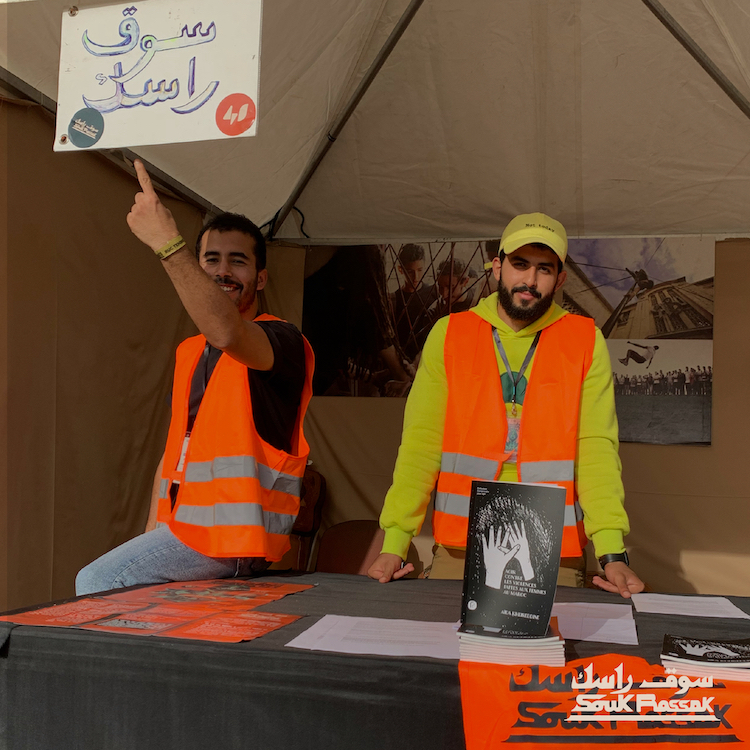
Specialized initiatives such as Souk Rassek help translate research findings and legal principles into concrete tools adapted to the realities of festive environments.
They provide teams with clear reference points, help transform freezing into the capacity to act, and contribute to creating an environment of trust that facilitates speaking out and mediation.
Conclusion
Gender-based violence in festive environments can be understood as the result of interconnected social, emotional and organizational dynamics that are never entirely fixed.
Recognizing these mechanisms does not mean restricting celebration or diminishing its cultural dimension. On the contrary, it means understanding the festive environment as a living, evolving and improvable space.
For cultural actors, this approach opens up the possibility of designing events where freedom, creativity and care are not in opposition, but mutually reinforce one another.
Bibliographical References
1 – Bows, H. (2024). Sexual violence at music festivals: Gendered harms, normalisation and the continuum of abuse. Journal of Gender-Based Violence, 8 (1), 1–18.
2 – Turner, V. (1982). From ritual to theatre: The human seriousness of play. PAJ Publications.
3 – Getz, D. (2010). The nature and scope of festival studies. International Journal of Event Management Research, 5(1), 1–47.
4 – Fileborn, B., Wadds, P., & Tomsen, S. (2020). Sexual harassment and violence at Australian music festivals: Reporting practices and experiences of festival attendees. Australian & New Zealand Journal of Criminology, 53(2), 194–212.
5 – Herman, J. L. (2015). Trauma and recovery: The aftermath of violence – from domestic abuse to political terror (2nd ed., pp. 33–47).
6 -This behaviour was observed during an intervention carried out by the Souk Rassek team at the Lboulevard Festival in October 2025. As the victim did not want to “bother us”, they chose to forget what had happened.
7 – SAFER : Structure qui accompagne les événements dans la mise en place d’un dispositif de luttre contre les violences sexistes et sexuelles à destinations de leurs publics
8 – Ouest-France. Les Vieilles Charrues visent l’exemplarité sur la prévention des violences sexistes et sexuelles. (30 mai 2024)
Ahmed, S. (2004). The cultural politics of emotion. Edinburgh University Press.
European Commission. (2022). Publications Office of the European Union. Safe spaces and prevention of gender-based violence in cultural and creative sectors.
Fileborn, B., Wadds, P., & Tomsen, S. (2020). Sexual harassment and violence at Australian music festivals: Reporting practices and experiences of festival attendees. Australian & New Zealand Journal of Criminology, 53(2), 194–212.
Getz, D. (2010). The nature and scope of festival studies. International Journal of Event Management Research, 5(1), 1–47.
Herman, J. L. (2015). Trauma and recovery: The aftermath of violence – from domestic abuse to political terror (2nd ed., pp. 33–47). Basic Books. (Original work published 1992)
Jones, C. (2020). Gender-based violence amongst music festival employees. In L. Platt & R. Finkel (Eds.), Gendered violence at international festivals: An interdisciplinary perspective (pp. 104–118). Routledge.
Organisation mondiale de la santé. (2002). World Health Organization.World report on violence and health.
Organisation mondiale de la santé. (2013).World Health Organization. Responding to intimate partner violence and sexual violence against women: WHO clinical and policy guidelines.
Quinlan, E., & Smith, M. (2019). Gendered bodies, public space and sexual harassment. Gender, Place & Culture, 26(2), 258–276.
Still, G. K. (2014). Introduction to crowd science. CRC Press.